Overview: Context and biography
B (*1955) is Q’s father, through whom we learned about the scholarship program and the West German humanitarian organization F. As Vietnam was a divided into a Northern and Southern part, B was citizen of South Vietnam.
Growing up, Q had always known that their father came to the city O. in Nordrhine-Westphalia in 1971 as a teenaged half-orphaned scholarship receiver, sponsored by organization AF., and that he still is in contact with the peers from his program cohort.
However, much of the details of this program remained fuzzy for Q, as this program, consisting of three cohorts from 1971 to 1973, was practically unheard of by most people in Germany, even among Vietnamese people, and B wasn’t in the habit of sharing much about his past life.
Q remembers learning that even before the collapse of South Vietnam and the end of the Vietnam War in 1975, B received a message from his family that he shouldn’t return to Vietnam because he would risk being drafted for military action like all his friends (who were without exception all killed in the war). After the message, he had no choice but to stay in West Germany, even though the scholarship was intended to last for only a few years before the scholarship holders were to return to Vietnam.
Since his passport from South Vietnam represented a country that no longer existed due to the lack of German residency title, he was granted an alien passport as a stateless person. In the interviews Q and NA learnt about his long way to building a secure life in Germany after his unforeseen stay here. He lives in Germany as a pensioner until this day.
When Q and NA first decided to apply to Wikimedia Deutschland’s Re:shape program, their main curiosity was to learn more about the program and the circumstances that made B become stateless, but through the numerous interview sessions with him, they learnt about the many horrid conditions and experiences he and others in his cohort had to face in in the program.
The interview findings are presented in the following.
About B’s life in Vietnam and his scholarship application
In Q and NA’s first interview with him, they asked him about his life in Vietnam and how exactly he received the scholarship.
When B was growing up in Sài Gòn (now Hồ Chí Minh City), his father was killed in action in the Vietnam War 1961. B’s mother received a widower’s pension by the South Vietnamese Ministry of Veterans Affairs, and B and his seven siblings were considered “Quốc gia nghĩa tử,” or “Nation’s orphans” – whose parent has fallen in the war for the country. This title allowed B to attend Trường Quốc Gia Nghĩa Tử, a school for the “Nation’s orphans,” established by the South Vietnamese government and overseen by the Veteran Ministry.
There were scholarship programs offered to the Nation’s orphans across different schools in South Vietnam at the time. Some ended up going to the U.K, some to Japan, some to the U.S.
In 1970, it was announced that there were scholarships available for students to study in West Germany. B, then 15, took the test and was ranked 21 out of the 14,000 applicants. The scholarship program was very selective: only 20 people would be selected, the applicants had to be in good health, and they had to be the first person in their family to be studying abroad. B’s friend, Hai, was among the 20 top scorers. However, since his sibling had already received a scholarship to go to English, he was disqualified from the selection process, yielding his spot to B instead. B always flashes a smile when telling the story, as if still surprised with his luck.
The only remaining personal object B possesses from his life in Vietnam before his migration in 1971 consists of his invitation to his scholarship interview at the Veteran Ministry (see right).
B shared with Q and NA, that growing up he was a fan of the US American singers Janis Joplin and Joan Baez.
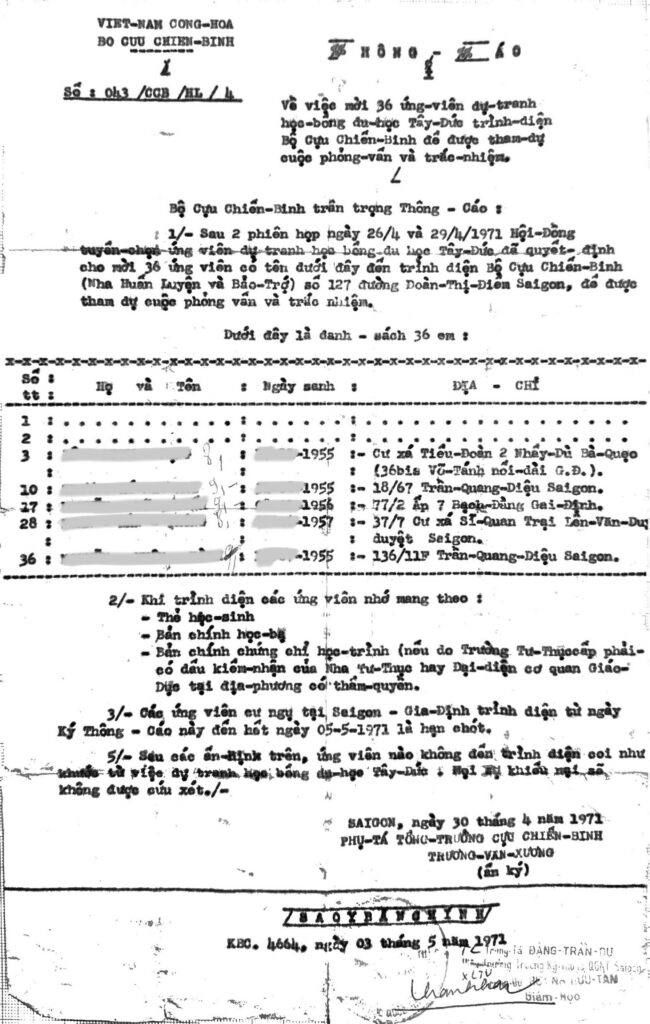
The constitution of the scholarship
It took Q and NA multiple interview sessions to reconstruct the scope of the scholarship, also due to the circumstance, that B was young when he became a scholarship recipient. While he describes some of his memories very vividly, other aspects of the program are remembered fragmentarily, especially those about the organizational constitution of it like: who initiated and funded the program, and from which financial means).
In the interviews we found out that the scholarship was initiated by the organization F. in cooperation with the Southern Vietnamese Veteran ministry. Set out as a program to grant Vietnamese young people education in the technical field in West Germany, they
The initial expectation by the scholarship receivers was that they would be granted a pathway to tertiary education, and a thorough accompaniment by F:
“We were told that there are machines in Germany, where all you need to is to push a button, and the machine serves you a hot bowl of phở.
B describes the expectations to be quite high due to the promises of the Veteran ministry and representatives of F., that they would not have to worry about anything in West Germany besides succeeding in their education. On July 9th their plane charted from Sài Gòn to West Germany.
First experiences of scholarship and Germany
When B arrived in Germany with his cohort, theI underwent a two-week integration course that covered the basics about German language and culture. Unlike other scholarships to English speaking countries, there was no language course prior to going abroad due to the lack of German teachers in Vietnam. After the course, the cohort quickly realized that the scholarship program did not provide a pathway to tertiary education contrary to their expectations of attending university for technical jobs. Instead, they were expected to begin traineeships, leading to immense disappointment among the scholarship recipients regarding unmet expectations. F sought companies who were looking to hire trainees and amilies to host the scholarship recipients, but to Q and NA’s shock there was no vetting process for host families.
The cohort split into a “girls group”, including six female nursing trainees, and a “boys group” consisting of 6 male scholarship recipients (among them B), who were sent to an hydraulics manufacturer in Bavaria, a frequent industry donor to F. Since the scholarship recipients were also ranging from age 12 to 16, none of them were equipped (also physically) to work manual labour. B recalls starting a traineeship alongside a very small and skinny 12-year-old boy, who had to stand on a wooden block to operate industrial machines due to his small size.
Also B’s group faced challenges adapting to life in Germany, especially with the harsh winter, as they arrived without any clue about winter and proper clothing. The organization F, which arranged the placements, failed to support B’s group, and even kept the trainees’ earnings while providing only a meager pocket money of 20 DM per month. F reasoned this by telling the scholarship recipients that they would safeguard the money, so that the recipients would have a big amount of money upon their return to Vietnam after their traineeship. B got increasingly frustrated about the conditions and advocated for higher financial allowance before F, and managed to increase their pocket money to 30 DM, which still wasn’t enough but allowed them to at least buy some muc needed winter clothing. Additionally, they struggled with lack of food, often resorting to stealing chicken to cook for themselves, as neither the organization nor our employer provided adequate meals.
Furthermore, the living conditions were inadequate for the teenage boys; they stayed in a Catholic boarding school without proper supervision. The growing anger and disappointment with the scholarship B contemplated quitting and returning to Vietnam. There, so he planned, he would get his high school graduation and then return to Germany, now eligible to enroll in university. He had already quit his traineeship when he learned about the war situation in Vietnam, through the sister who advised him against returning due to the risk of being drafted into the military and wasted as cannon fodder in the last period of war, like it happened to many young men in Vietnam. This news was extremely difficult for B, and Q remembers B sharing how, after that phone call, B drank heart boost every day for a whole month, for the pain and suffering he experienced were profound. Eventually, he decided to stop drinking after that month (and for the rest of his life) and reflect on the future direction of his life.
He decided to return to O. and live and work at the F facility for a while. Upon his return, he worked as a handyman and janitor, assisting the facility manager with cleaning and repairs. During this time, he also requested to receive his earnings from his previous traineeship, and was eventually paid out. A quick calculation by Q and NA suggests that F. compensated him significantly less (less then 50%) than he was entitled to his own earnings.
After the traineeship and the war
While working at F, B gained a deeper understanding of its operations, including the donation system, the public attention it received, as well as the need to maintain the image of an humanitiarin organization in need for donations to support the children. At that time, F received many donations, including money and material goods like clothing and furniture from various individuals and businesses across West Germany. B recalls being instructed by F to burn and destroy material donations to prevent visitors from thinking there was an abundance of resources available. He also remembers significant internal conflict within the organization, particularly between the general manager and co-founder and the face of the org, Pastor B. He described that the division created pressure for the children at F., who felt they had to choose which side to be loyal to. Additionally, there were numerous accusations regarding the acquisition and use of donations. In the further research and interviews with B, it became clear that B. had faced demotion due to allegations of sexual misconduct involving a minor in his protestant community. B confirmed this and mentioned that the sexual misconduct was widely known or at least assumed within the environment of F.
By chance, B met a German couple running a gas station and repair shop near O. They frequently visited F and were aware of the children’s situation and the internal conflicts there. They offered him a traineeship as a car mechanic, which B accepted. In 1976, he moved out of F to work and live with the couple and their two children for the next ten years. During this time, he completed his traineeship, gained work experience, and became eligible to enroll in technical school, where he earned a degree that expanded his job opportunities. After working in a plastic manufacturing factory, he had the chance to work for a hydraulics manufacturer in Bavaria in 1986. Following a brief job interview, he was hired as mechanical drafter and continued working there until his retirement in 2020.
The long way from stateless, to small asylum to citizenship
After the end of the Vietnam War, his residency status was unclear. As a citizen of a now-defunct country, his Southern Vietnamese passport expired, leaving him without a valid residence title. However, since he was employed, he obtained an alien passport from immigration while the newly forming Vietnamese government categorizing him as their citizen. He learned from peers in similar situations that he could go to the embassy of the now reunified Vietnam to apply for a new passport, but he was afraid to take that step for several reasons: Vietnamese citizens who had lived abroad were monitored and viewed suspiciously by the new government due to potential foreign affiliations. Additionally, like many scholarship recipients, he was classified as a national orphan, with parents, often fathers, who had served in the military of the former South Vietnam. The new government was particularly strict with those known to have political or military ties to southern Vietnam.
The German couple and their family helped him gather information about securing residency status, suggesting he apply for asylum at the immigration office. Around the late 1970s, the so-called Boat People refugees arrived in West Germany. They were quickly categorized as humanitarian refugees escaping communism and were granted residency by West Germany, allowing them to live and work in West Germany permanently. When B however visited the immigration office, his asylum application was denied because, unlike the boat people, he had already been residing in Germany since 1971 and was not fleeing a country. He fell under the category of a person who would risks persecution if returned to Vietnam, and was granted the “17a”, colloquially known as small asylum. While this small asylum status provided him with a more secure residency title, it meant he was ineligible for family reunification, unlike other refugees. He felt happy for fellow Vietnamese refugees who could reunite with their families in Germany, yet it was bittersweet for him that he could not.
In 1984, he obtained a residence title and later achieved permanent residency through his employment. During this time, he occasionally met Vietnamese students traveling from Vietnam to West Germany. They offered to carry letters and cash for his family in Ho Chi Minh City, one of the thin threads of connections he managed to hold to his family there.
By 1989, as the Soviet Union and Eastern Bloc began to collapse, he started to hope for a trip back to Vietnam to see his family. Although eligible for German citizenship due to his long-term employment, he postponed it to retain his Vietnamese citizenship, which would allow him to enter Vietnam more easily.
In 1991, following the dissolution of the Soviet Union and the reunification of Germany, he seized the opportunity to visit Vietnam for the first time in 20 years for four weeks. There, he met a woman, Q’s mother whom he married shortly before he returned to Germany. Prior to his travels, he had applied for German citizenship, and after returning from Vietnam, he was naturalized, which also granted him the right to reunite with his wife. After four months of waiting, his wife was granted a family reunification visa to live with B. They still live together in Bavaria.